Introduction To Probability, 2nd Edition
Introduction To Probability, 2nd Edition
Couldn't load pickup availability
Description
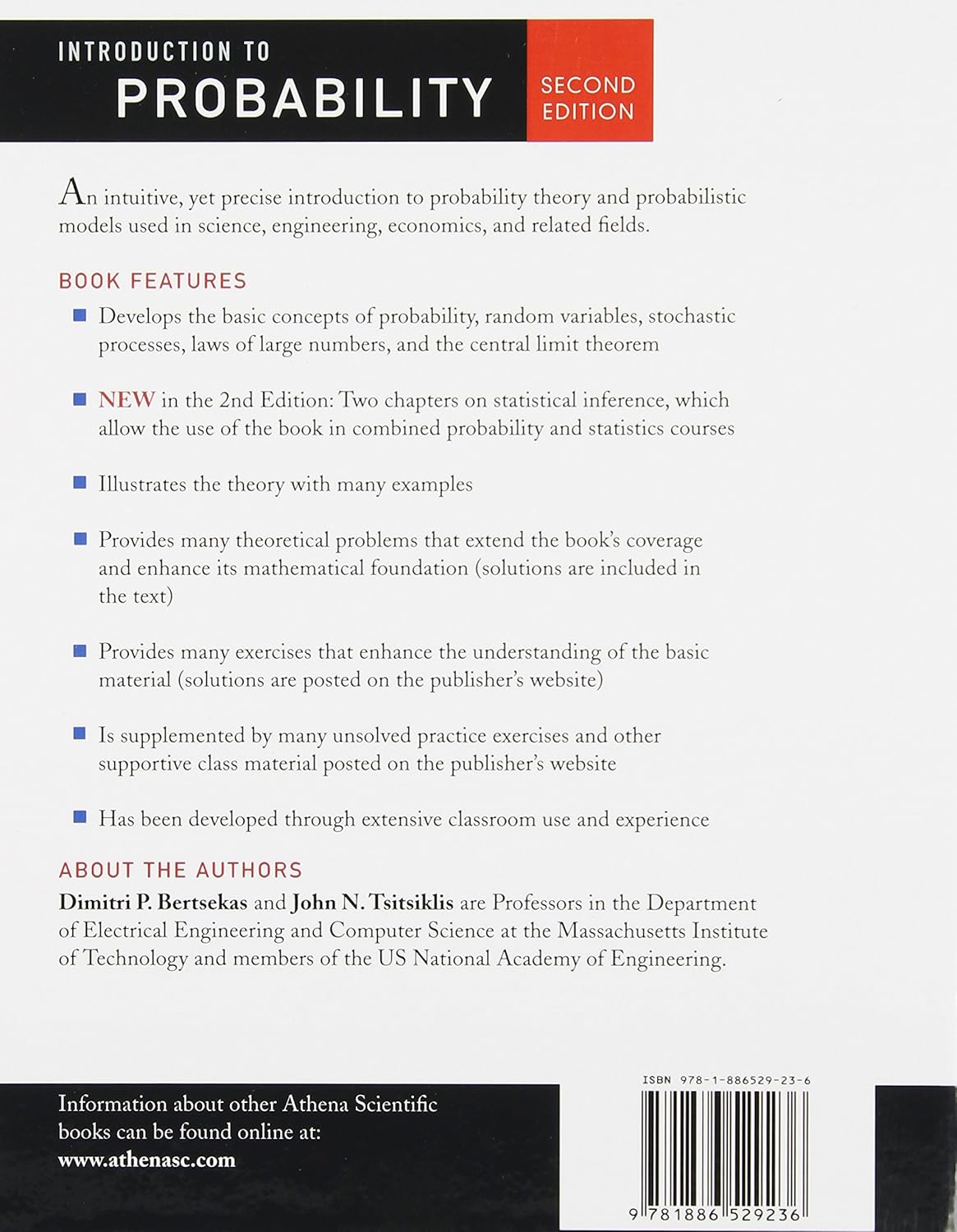
An intuitive, yet precise introduction to probability theory, stochastic processes, and probabilistic models used in science, engineering, economics, and related fields. The 2nd edition is a substantial revision of the 1st edition, involving a reorganization of old material and the addition of new material. The length of the book has increased by about 25 percent. The main new feature of the 2nd edition is a thorough introduction to Bayesian and classical statistics.
The book is currently the textbook for Probabilistic Systems Analysis, an introductory probability course at the Massachusetts Institute of Technology, attended by a large number of undergraduate and graduate students. It covers the fundamentals of probability theory—including probabilistic models, discrete and continuous random variables, multiple random variables, and limit theorems—which are typically part of a first course on the subject. It also introduces the fundamental concepts and methods of statistical inference, both Bayesian and classical.
In addition, the book contains a number of more advanced topics, allowing instructors to tailor the material to the goals of a particular course. These topics include transforms, sums of random variables, and a fairly detailed introduction to Bernoulli, Poisson, and Markov processes. The book strikes a balance between simplicity in exposition and sophistication in analytical reasoning. Some of the more mathematically rigorous analysis is intuitively explained in the text, but developed in detail (at the level of advanced calculus) in numerous solved theoretical problems.
Written by two professors from the Department of Electrical Engineering and Computer Science at the Massachusetts Institute of Technology, and members of the prestigious US National Academy of Engineering, the book has been widely adopted for classroom use in introductory probability courses both in the USA and abroad.
From a review of the 1st edition: the book trains intuition to develop a probabilistic “feeling.” It explains every single concept it introduces. This is its main strength: deep explanation, not just examples that happen to illustrate concepts. Bertsekas and Tsitsiklis leave nothing to chance, making the probability of misinterpreting a concept or failing to understand it effectively zero.
Numerous examples, figures, and end-of-chapter problems strengthen understanding and reinforce the material presented in the text.
Product Details
Share